Monday, 11 May 2015
cardboard city - Wire Frame Drawing
The wire frame drawing that i completed is not present here as the photos were lost. I created a person out of rubber coated thick wire and added a heart made out of red wire attached to it. Along with all the others, I added mine to the Theatre D'Ombre based on Boltanski's work. Here is a picture of it:

Thursday, 7 May 2015
cardboard city - Living sketchbook
Here is a documentation of the "living sketchbook" that i drew on the window of college. It shows a dinosaur/godzilla creature attacking the town hall with fire before a meteor kills it. It is a time lapse, and therefore time based media. It doesn't translate as well as it could have and a clearer message; the transition from beginning to end is messy and unclear. However it is effective and I feel I used the landscape of the picture to an advantage.


Wednesday, 8 April 2015


Tuesday, 24 March 2015
Vintage project evaluation
The era I have chosen for the vintage project is the 1950s. I
have chosen this era because it wasn’t popular among other people in the class
and there are many events that took place that interest me in the decade, such
as the cold war and the atomic age that had started. I wanted to explore more
about the films and comics industries from the 1950s and the red scare.
I researched both images and info for every page I did,
including dates, context, etc. Towards
the end of my sketchbook I started to focus on more obscure subjects such as
horror comics, movies, artists and popular technology of the time. These I felt
I could explore with more enthusiasm so left them until the end to help me anticipate
finishing the sketchbook.
The main cultural references in my era are focused on the
rock and roll era and the fashion and hairstyles that were present in the
decade. I have also focused on the then fully active cold war between the US
and Russia and the repercussions of their conflicts.
Artists I studied in my sketchbook are Jackson Pollock, Mark
Rothko and Willem De Kooning. The main art movement in the era was Abstract Expressionism
and cubism. I think that the age of impressionism had become very old in its
style and relevance in the 1950s and with cubism, abstract and other forms of
expressionism becoming popular, artists had started to paint much more simply.
I have used a wide variety of media in my sketchbook including
brush pens, pencil, acrylic paint, oil pastels, coloured pencil, marker pen,
pro markers and water colour paints. I used brush pens to replicate a comic
book effect, the acrylic paint splattered on the page to replicate Jackson Pollock’s
style and pencil to achieve the best detail in studies of people or scenery for
examples.
The annotations’ positions could have been more creative in
how I added them alongside the drawings. I wrote them close to the images on
the pages.
In hindsight, I could have managed my time a lot better,
often having to rush because of taking too long on certain pages. To improve I could
have studied more relevant subjects, for example, maybe cut out the page on
toys, and definitely included more sketches on pages like movies and
hairstyles.
I am happy with the
final outcome of my sketchbook and despite the problems mentioned before, I am
proud of how some of the sketches have turned out and could be some of my best.
Experimental Portrait Project Evaluation
I
decided to produce a portrait of one of my peers (Kieron Pickering) for this
project because I found it more productive to take photos as well as being more
challenging.
I think that although I was behind by the end, I didn’t manage my time as poorly as other projects. It was referred with
Within the time frame I could have produced
I think that although I was behind by the end, I didn’t manage my time as poorly as other projects. It was referred with
Within the time frame I could have produced
The
project has helped me I think with using different media in my work, as well as
improve my skills of drawing faces.
Tuesday, 17 March 2015
cardboard city - Christian Boltanski
French sculptor, photographer, painter and filmmaker. Self-taught, he began painting in 1958 but first came to public attention in the late 1960s with short films and with the publication of notebooks in which he came to terms with his childhood. The combination in these works of real and fictional evidence of his and other people's existence remained central to his later art.
In the 1970 s photography became Boltanski's favourite medium for exploring forms of remembering and consciousness, reconstructed in pictorial terms. In the early 1980 s Boltanski ceased using objects trouvés as a point of departure. Instead he produced 'theatrical compositions' by fashioning small marionette-like figures from cardboard, scraps of materials, thread and cork, painted in colour and transposed photographically into large picture formats. These led to kinetic installations in which a strong light focused on figurative shapes helped create a mysterious environment of silhouettes in movement.
In 1986 Boltanski began making installations from a variety of materials and media, with light effects as integral components. Such works, for which he used portrait photographs of Jewish schoolchildren taken in Vienna in 1931, serve as a forceful reminder of the mass murder of Jews by the Nazis. In the works that followed Boltanski filled whole rooms and corridors with items of worn clothing as a way of prompting an involuntary association with the clothing depots at concentration camps. As in his previous work, objects thus serve as mute testimony to human experience and suffering.
I am very fond of Boltanski's work as I find it eerie and skeletal. The Theatre des Ombres reminds me of a tribal painting scene but with a contemporary twist involved.
http://classconnection.s3.amazonaws.com/135/flashcards/908135/png/cboltanski-shadows1330304010103.png

http://floresenelatico.es/wp-content/uploads/2011/11/Boltanski_2.jpg

http://www.moma.org/collection_images/resized/229/w155h170crop/CRI_180229.jpg

https://s-media-cache-ak0.pinimg.com/736x/2c/70/dd/2c70dde2176471122e2e6ec4793640f3.jpg

In the 1970 s photography became Boltanski's favourite medium for exploring forms of remembering and consciousness, reconstructed in pictorial terms. In the early 1980 s Boltanski ceased using objects trouvés as a point of departure. Instead he produced 'theatrical compositions' by fashioning small marionette-like figures from cardboard, scraps of materials, thread and cork, painted in colour and transposed photographically into large picture formats. These led to kinetic installations in which a strong light focused on figurative shapes helped create a mysterious environment of silhouettes in movement.
In 1986 Boltanski began making installations from a variety of materials and media, with light effects as integral components. Such works, for which he used portrait photographs of Jewish schoolchildren taken in Vienna in 1931, serve as a forceful reminder of the mass murder of Jews by the Nazis. In the works that followed Boltanski filled whole rooms and corridors with items of worn clothing as a way of prompting an involuntary association with the clothing depots at concentration camps. As in his previous work, objects thus serve as mute testimony to human experience and suffering.
I am very fond of Boltanski's work as I find it eerie and skeletal. The Theatre des Ombres reminds me of a tribal painting scene but with a contemporary twist involved.
http://classconnection.s3.amazonaws.com/135/flashcards/908135/png/cboltanski-shadows1330304010103.png
http://floresenelatico.es/wp-content/uploads/2011/11/Boltanski_2.jpg
http://www.moma.org/collection_images/resized/229/w155h170crop/CRI_180229.jpg
https://s-media-cache-ak0.pinimg.com/736x/2c/70/dd/2c70dde2176471122e2e6ec4793640f3.jpg
cardboard city - college recreation
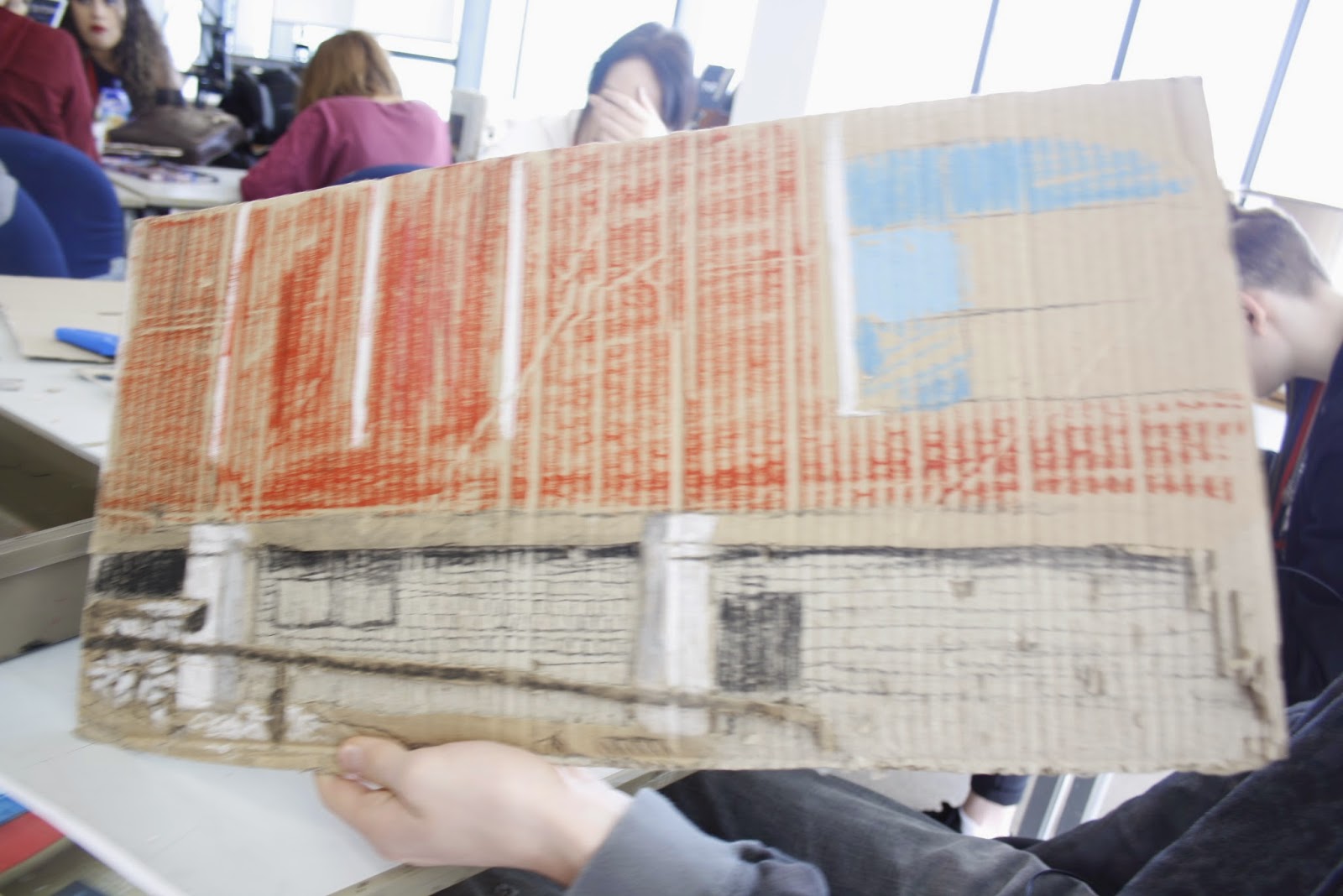
Here are some photos of me recreating a photo of barnsley college in cardboard. I have added depth to it by cutting out the parts most farthest away to bring the fore ground to the front. I coloured it using oil pastels, chalk and charcoal.







Subscribe to:
Posts (Atom)